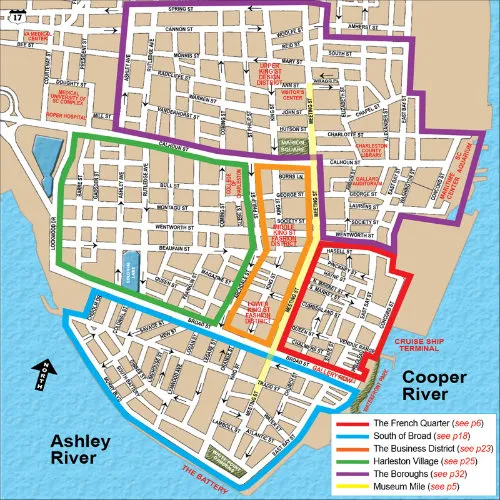
With all of the grace and charm of a Southern city, Charleston draws in visitors and residents with its historic charisma and waterfront panoramas. Stroll down King Street to browse boutiques, wander through art galleries in the French Quarter, or tour some of the city's historic homes. The peninsula is home to a rich history that is revealed in nearly all of its building, streets and parks.
The city, originally named Charles Towne was founded in 1670 in current day West Ashley and started with about 30 houses. It moved to the peninsula 20 years later and grew to encompass several thousand inhabitants as it became a major trading center.
After weathering several hurricanes, and French and Spanish attacks during the 1700's, Charleston became a royal colony in 1921.
Charleston began to take shape as a major city, adding cultural, residential and commercial aspects. Businesses popped up, such as the country's first fire insurance company and one of the country's first theaters. Several historic landmarks were built, including the East Bay Warehouse district, which is now Rainbow Row, and lots laid out in 1745 for the first neighborhood, Ansonborough.
The first church services at St. Michaels Episcopal Church on Broad Street were held in 1761. It is now the oldest church building in the city. The Charleston Museum was established in 1773 as the first museum in what would become the United States.
Several major Revolutionary battles unfolded around Charleston, and the city eventually fell under British control for two years before it was incorporated in 1783.
The College of Charleston was granted a charter in 1785 and the school has a large physical presence in downtown Charleston to this day.
In 1824, the Medical University of South Carolina was founded, becoming the first medical school in the South. The MUSC campus and hospital occupy a large area on the peninsula's west side between Calhoun and Bee streets, where a cluster of other health care providers have hospitals such as Roper St. Francis and the VA Medical Center.
The South Carolina legislature established a municipal guard in 1822 to protect the city of Charleston and the surrounding area. The newly formed military force was given land both for the storage of weapons and for a guard house. In 1829, a building called the Citadel was built in Charleston's Marion Square. A similar building called the Arsenal sprang up to the north in the state capital of Columbia in 1833.
But it wasn't until the governor of South Carolina decided that the troop's guard duties should be combined with education that The Citadel began to take shape. State lawmakers established the South Carolina Military Academy in 1842. Troops in both the Citadel and the Arsenal were replaced by students, who were then and now called the South Carolina Corps of Cadets. The military training program resembled that of another U.S. military academy you've probably heard of: West Point. Initially, the Arsenal and the Citadel operated independently, but later were combined for economic reasons.
Citadel cadets have fought in every U.S. war starting with the Mexican War of 1846, which established the fledgling academy's reputation for military instruction. During the Civil War, the Corps of Cadets became part of the state troops and fought in several battles defending Charleston. In 1865, Union troops burned down the Arsenal, and they also set up camp in the Citadel, forcing it to close temporarily.
In 1842 the Citadel reopened and re-established its military education program. In 1910, the name was changed from the South Carolina Military Academy to The Citadel, the Military College of South Carolina. In 1922, the growing college moved to its current campus along the Ashley River.
The Citadel is a public, state-supported, senior military college. Its undergraduate student body numbers more than 2,000. The school offers bachelor's degrees in sciences, mathematics, English, modern languages, computer science, engineering and many other fields of study.
All cadets enroll in Reserved Officers' Training Corps (ROTC) instruction in the. military branch of their choice, such as the Marines. Unlike West Point or other federal services academies at which the U.S. government pays for students' tuition in exchange for military service, Citadel cadets aren't required to join the military upon graduation. But about 30 percent of Citadel grads do choose to receive an officer's commission and join the military each year. Since 2001, more than 1,300 Citadel alumni have served. A small number of cadets in the National Guard and Reserves have been called to serve while enrolled in college, but that doesn't happen often, except say, in 1944, when the entire class of 1944 was called to fight in World War II.
Citadel cadets must meet the same height and weight requirements used by the U.S. Army. Once enrolled, potential cadets must pass a physical test of push-up repetitions, sit-up repetitions and a timed 2-mile (3.2-kilometer) run.
Despite a major earthquake in 1886 and Hurricane Hugo in 1989, Charleston still has some of the most historic homes and buildings in the South. A designated "historic district" preserves many residential properties.

Circa 1754, the Charles Warham house. Lovingly restored, this fine 18th century masonry home features to-the-period woodwork, beautifully scaled rooms overlooking a priva...

Just steps from Colonial Lake, 201 Broad Street, Unit 2 is a charming two-bedroom, two-bathroom condo in the heart of Charleston's sought-after South of Broad neighborhoo...

Welcome to 35 & 35 1/2 Cannon Street, a rare, turnkey three-unit short-term rental investment opportunity in Charleston's highly desirable Cannonborough-Elliotborough nei...

Behind Charleston's most iconic wrought iron gates lies one of America's most extraordinary historic residences: the legendary Sword Gate House. Located along prestigious...

Fabulous South of Broad townhome just steps from Rainbow Row and the Battery. Built new in 2001, the high elevation offers 3 levels of living space above a rare 3-car gar...

Charleston's storied Victorian masterpiece reimagined to embrace history, family, and grand celebrations for the next century. Standing proudly among only ten residences ...

Situated in Charleston's historic South of Broad neighborhood, 118 & 120 S Battery is a distinguished Colonial-style residence offering generous living spaces, beautiful ...

Welcome to 45 East Bay Street Unit A, a rare opportunity to own a piece of Charleston history. This elegant residence is on the first floor of the grand Somersall-Desauss...

Circa 1746. The John Prue House.This fine, pre-revolutionary home built by master carpenter Prue, where he resided until 1773. The home is complete with 18th century wood...

Circa 1768 -- The Joseph Veree House. Classic early Georgian architecture graces this wonderful South of Broad home. To-the-period proportions and scale combined with mod...

69 Church Street represents one of Charleston's most significant residential offerings, a grand pre-Revolutionary estate of exceptional architectural pedigree, remarkable...

Tucked away on one of Charleston's most private and quiet streets, 7 Greenhill is a rare piece of 18th-century Charleston. Built circa 1760, the home is entered through a...

Positioned at one of Charleston's most dynamic intersections, where King Street's energy meets the open green space of Marion Square and just steps from the College of Ch...

If you have been searching for the perfect South of Broad pied-a-terre, 139 Tradd Street, Unit 1 offers a rare combination of historic character, sophisticated renovation...

Tucked away on a quiet residential court just off Romney Street, 14 Boyer Ct is a beautifully refreshed 1915 historic single family home in Charleston's booming Upper Pen...

Set on one of South of Broad's most storied streets, this circa-1760 masonry residence is a rare pairing of authentic Charleston history with a no-expense-spared renovati...

The iconic Stevens-Lathers antebellum mansion is a celebrated, important property in Charleston, located at the tip of the Peninsula across from White Point Garden. Rece...

Tucked away on wonderful Greenhill Street, this exceptionally charming three-bedroom cottage is filled with natural light and inviting architectural details throughout. A...
